Explore Lisbon: Property Prices, Rent, Cost of Living and What to Do in 2026
Lisbon sits on seven hills above the mouth of the Tagus, which is why the city looks the way it does and why walking it is harder than the map suggests. It is the westernmost capital in mainland Europe, it gets around 2,800 hours of sunshine a year, and it is close enough to the Atlantic that you can be swimming forty minutes after leaving the office.
It is also the most expensive place in Portugal to buy or rent a home, by a wide margin, and the gap between what people expect to pay and what they end up paying is where most of the trouble starts.
This guide covers both sides. What Lisbon costs, using the prices actually registered with the tax authority rather than the ones advertised on property portals. Where to live and why. How to get around. And what is worth your time once you are here.
Key Takeaways: Exploring Lisbon in Six Steps
- Set a monthly number before you look at anything. A single person renting a one-bedroom flat in Lisbon and living comfortably needs roughly 1,900 to 2,600 euros a month once rent, bills, transport and food are counted. A couple in a two-bedroom flat lands closer to 2,600 to 3,400 euros. Everything else follows from that number.
- Separate advertised prices from registered prices. Portal listings sit well above what gets signed at the notary. Statistics Portugal publishes the registered medians every quarter, broken down to parish level for Lisbon, and the difference runs to hundreds of euros per square metre.
- Pick the parish before the property. Lisbon has 24 parishes and they differ by more than 2,500 euros per square metre. The fastest growth in the past year has been in the outer ones, not the historic centre.
- Budget the purchase costs separately. Transfer tax, stamp duty, notary and registry are paid at deed and sit on top of the price. On a Lisbon flat they are a meaningful line item, not a rounding error.
- Get someone on your side of the table. Over the 12 months to March 2026, buyers with a foreign tax domicile paid a median of 6,325 euros per square metre in Lisbon. Buyers with a Portuguese tax domicile paid 5,000 euros for the same city. Part of that is what foreign buyers choose to buy, and part of it is the negotiation. Ola Estate represents the buyer or the tenant rather than the listing, and includes legal review of every contract, which is where that second part gets addressed.
- Check what is actually open before you plan around it. Three of Lisbon's four funiculars are still closed after the 2025 Glória accident. The metro's Circular Line has slipped to 2027. The new airport is now a 2035 project. Guides written in 2024 and 2025 get all three wrong.
Lisbon at a Glance
Lisbon in 2026
The shape of the city is the product of one event. The 1755 earthquake and the tsunami and fires that followed destroyed most of the lower town. The Marquis of Pombal rebuilt it on a grid, with standardised facades and an early anti-seismic timber cage inside the walls, which is why Baixa looks like nowhere else in the old city. Alfama survived because it sits on bedrock, which is why it still has the medieval street plan.
What Property Actually Costs in Lisbon
The number most guides get wrong
If you search for Lisbon property prices you will be given a figure somewhere between 6,000 and 7,500 euros per square metre. That is an asking price, scraped from listing portals. It tells you what sellers hope for.
The figure that matters is what was declared when transfer tax was paid. Statistics Portugal publishes that number quarterly, built from anonymised Tax Authority records, and the 1st quarter 2026 release came out on 17 July 2026.
For the municipality of Lisbon, the registered median across the 12 months to March 2026 was 5,082 euros per square metre, up 15.2% on the previous year. In the first quarter of 2026 alone the median was 5,292 euros per square metre, the highest of any municipality in the country. Cascais followed at 5,000 euros and Oeiras at 4,511.
For context, the national median in the same quarter was 2,337 euros per square metre. Lisbon is more than twice the country.
Registered sale prices by Lisbon parish
This is the level of detail that changes decisions, and it is the part almost no guide publishes. All figures are registered medians for the 12 months to March 2026.
A note on what this table is. Statistics Portugal names a different subset of parishes in each quarterly release, depending on which ones cross the thresholds it reports against. The figures above are the ones named in the release of 17 July 2026. The full 24-parish series is published in the institute's database rather than in the summary bulletin, and it is worth checking directly if a specific parish matters to your decision.
Four other parishes have appeared above the city median in recent releases: Campo de Ourique, Estrela, Misericórdia and Campolide. Treat them as sitting between roughly 5,100 and 6,000 euros per square metre rather than assuming a precise figure.
The direction of travel is easier to read than any single number. On the same 12-month rolling basis and the same method, the Lisbon municipal median was 4,875 euros per square metre for the year to December 2025 and 5,082 euros for the year to March 2026. That is 207 euros per square metre added in one quarter of rolling data, or about 4.2%.
Three details from the July release are worth more than the table.
- Ajuda recorded the strongest growth of any Lisbon parish, at 23.9%. It is one of the least fashionable parts of the city, up the hill behind Belém, and it is where the money moved.
- Only two parishes fell: Santa Maria Maior at −0.5% and Marvila at −0.4%. Santa Maria Maior is Baixa, Alfama and the castle. It is the most photographed square kilometre in Portugal and the only central parish where prices went backwards.
- Arroios recorded the most transactions of any parish, 655. Carnide recorded the fewest, 96. Liquidity matters when you come to sell, and a parish with 96 sales a year gives you very little to compare against.
The pattern is consistent. Money is leaving the saturated tourist core and going into the ring around it.
The gap between foreign and domestic buyers
The same dataset splits transactions by the buyer's tax domicile, and the result is blunt.
That is 26.5% more per square metre. On an 85 square metre flat it works out to roughly 113,000 euros.
Across Greater Lisbon in the first quarter of 2026 the same gap was 34.5%. It is real, it is published, and it is narrowing: the equivalent figure for the first quarter of 2024 was 82.3%.
Part of the gap is composition. Foreign buyers cluster in Santo António, Avenidas Novas, Estrela and Parque das Nações, they buy renovated stock, and they buy larger. Part of it is that a buyer who does not read Portuguese, does not know what the neighbouring flat sold for and is negotiating through the seller's agent has no leverage. The first part is a choice. The second part is fixable.
New builds versus existing stock
Lisbon has the widest new-build premium of any large municipality in Portugal. Over the 12 months to March 2026 the registered median was 6,226 euros per square metre for new homes against 4,896 for existing ones, a difference of 1,330 euros per square metre.
On a 90 square metre flat that is about 120,000 euros for the same floor area. New build in Lisbon usually means a full gut renovation of an old building rather than new construction, so the question to ask is what was actually replaced: structure, roof, plumbing, wiring, or only the kitchen and the paint.
What you pay on top of the price
The advertised price is not the amount that leaves your account. Budget separately for:
- IMT, the property transfer tax, calculated on a sliding scale against the purchase price or the taxable value, whichever is higher
- Stamp duty at 0.8% of the purchase price
- Notary and land registry fees
- Legal fees, if your agency does not include contract review
- Mortgage costs if you are borrowing: valuation, arrangement fee and stamp duty on the loan itself
- IMI, the annual municipal property tax, from the following year onwards
You will also need a Portuguese tax number before you can sign anything, including the promissory contract. We have covered the transfer tax bands, the promissory contract and the non-resident mortgage process in separate guides.
What It Costs to Rent in Lisbon
The official numbers
Statistics Portugal resumed publishing new-contract rent statistics in June 2026 after a pause of several months, having integrated a wider set of Tax Authority records. The universe of contracts covered grew by about half, and the median barely moved, which is a good sign for the reliability of the series.
For the first quarter of 2026, the median rent on new contracts signed in the municipality of Lisbon was 17.42 euros per square metre, up 8.2% year on year. That is the highest in Portugal. Cascais and Oeiras came next. Greater Lisbon as a region was 14.38 euros, and the national median was 9.46 euros.
Translated into monthly rent, using the Lisbon median:
The left column is what the median contract implies. The right column is what you will see advertised, particularly for furnished flats marketed to internationals. Both are true at once. Furnished, short-notice, English-language listings in Chiado and Príncipe Real are a different market from the unfurnished 12-month contract a Portuguese family signs in Benfica, and the official median blends them.
What that means in practice
- Unfurnished flats are meaningfully cheaper than furnished ones and are what most long-term contracts cover. Budget for appliances.
- Rooms in shared flats start around 450 euros and typically run 500 to 700 in the central parishes.
- Rent is usually quoted excluding condominium charges, water, electricity and gas. Ask what is included before you compare two flats.
- Supply is tight and moves fast. Good long-term listings at market price are often gone within days, which is why viewing remotely and deciding quickly matters more here than in most European cities.
Deposits, guarantors and paperwork
Landlords in Lisbon commonly ask for two to three months of rent as a deposit plus the first month in advance, and many ask for a Portuguese guarantor (fiador) or several months paid up front instead. Expect to show a tax number, proof of income, an employment contract or company documents, and identification. We have a separate guide covering the full document list and what to do if you have no Portuguese income history.
What changed in the rental law in 2026
Three changes are worth knowing:
- The 2% cap on new contracts was repealed. It limited how much a landlord could raise the rent when signing a new lease on a property let within the previous five years. The government approved its early removal in July 2026 as part of a wider rental reform package.
- Existing contracts still follow the annual coefficient. For 2026 that is 1.0224, so a maximum 2.24% increase, and it has to be notified in writing within the legal window.
- Tenants can deduct rent against income tax. Up to 900 euros in 2026, rising to 1,000 euros in 2027, for leases at what the law defines as moderate rent. Your contract has to be registered with the Tax Authority for this to work, which is one of several reasons never to accept an unregistered lease.
Cost of Living in Lisbon in 2026
A realistic monthly budget
Rent aside, Lisbon is cheap by Western European standards and expensive by Portuguese ones. The figures below are working ranges rather than official statistics, and they assume you cook most evenings, use public transport and eat out two or three times a week.
Add schooling if your children are not going into the public system. International school fees in Lisbon start around 9,000 euros a year and go well past 20,000 at the established British and American schools.
Utilities and the winter problem
Portuguese housing stock is poorly insulated and most Lisbon flats have no central heating. Summer electricity bills are low. Winter bills are not, because everyone runs electric heaters and dehumidifiers from December to February. Budget 80 to 150 euros a month for electricity, water and waste on a two-bedroom flat, and expect the January bill to be double the July one.
When you view a flat in summer, ask which direction it faces, whether the windows are double-glazed, and whether there is any heating at all. A north-facing ground floor in Alfama is a different property in January than it is in July.
Food, coffee and eating out
A coffee at the counter is 80 cents to 1.20 euros. A lunchtime prato do dia in a local tasca is 9 to 13 euros including soup and a drink. A mid-range dinner for two with wine is 45 to 70 euros. A tourist-facing restaurant on a square in Baixa will charge double for worse food, and the couvert of bread, olives and cheese put on your table before you order is not free.
Supermarkets are cheap. Continente, Pingo Doce and Auchan for the weekly shop, Lidl and Mercadona for the price, Minipreço for convenience. Fresh fish and produce are better and cheaper in the municipal markets: Mercado de Campo de Ourique, Mercado 31 de Janeiro and Mercado de Arroios among others.
[[banner:w-image-1]]
headline: Need help understanding mortgages in Portugal?
description: Download our free guide for non-residents and get a clear overview of rates and requirements
button: Download the guide
url: https://drive.google.com/file/d/1M3btj0Dz-3zUlZr-SZ-KAUw7DC4E3HQg/view
image: https://cdn.prod.website-files.com/699c52fd0ea2d4bb2148d179/69d3c297a90daeeab9240bb8_Container-5.avif
color: orange
[[/banner]]
Healthcare
Legal residents can register with the national health service (SNS) through their local health centre and receive care at low or no cost. Waiting times for non-urgent specialist appointments are the main complaint. Most residents who can afford it also carry private insurance, which is inexpensive by international standards and gets you into private hospitals such as Luź, CUF and Hospital dos Lusíadas quickly.
Salaries, and why the maths feels strange
The national minimum wage in 2026 is 920 euros gross a month, which nets 818.80 euros after social security. Statistics Portugal put the average monthly wage at 1,694 euros in 2025.
Set those against a median new-contract rent of 17.42 euros per square metre and you have the central tension of the city. Lisbon feels affordable if you earn abroad and inexpensive if you compare it to Paris or Amsterdam. It does not feel affordable on a Portuguese salary, which is the reason housing dominates local politics and the reason short-term rental rules keep tightening.
Lisbon Neighbourhoods: Where to Live and Why
Lisbon is small. The whole municipality is about 100 square kilometres and you can cross the built-up centre on foot in an hour, hills permitting. Choosing an area is mostly about noise, hills, and how far you are willing to be from a metro station.
The historic core
Baixa, Chiado, Alfama, Mouraria and Bairro Alto are beautiful and difficult to live in. Buildings are old, lifts are rare, noise carries, and a large share of the flats around you are short-term rentals with a new set of suitcases every three days. Santa Maria Maior, the parish that holds most of this, is one of only two in the city where registered prices fell over the past year.
They are excellent for a first six months, when you want to be in the middle of everything and are not yet committed. Many people then move out.
The residential middle
Campo de Ourique is the neighbourhood people name when asked where they would live if money were not the issue: a proper high street, a good market, parks, schools, and a village feel on a plateau. Estrela and Lapa are quieter and grander, with embassies and the Basilica and the best garden in the city. Alvalade is a planned 1950s district with wide pavements, mature trees and an actual neighbourhood market, and it is the one to look at if you want family life without paying Campo de Ourique prices.
Avenidas Novas and Areeiro are where the offices are, which means good transport and less atmosphere. Arroios is the most interesting of the middle group: cheap five years ago, no longer cheap, and the parish with the highest transaction volume in the city.
The outer ring
This is where the growth is. Benfica, Lumiar, Olivais and Penha de França all registered double-digit price growth over the past year and all sit between 4,300 and 4,700 euros per square metre, roughly a third below Santo António. They are served by metro, they have supermarkets and schools, and they are full of Portuguese families rather than short-term rentals.
Marvila and Beato are the interesting edge case: former industrial riverside east of the centre, now full of breweries, galleries and converted warehouses, with new residential schemes going up. Marvila was the other parish where registered prices dipped in the past year, which usually reflects a change in what is being sold rather than a falling market.
Outside the municipality
Plenty of people who say they live in Lisbon do not. The Cascais line runs west along the river to Oeiras, Carcavelos, Estoril and Cascais, which gives you beaches, international schools and a 30 to 40 minute commute. Oeiras registered 4,511 euros per square metre in the first quarter of 2026 and Cascais 5,000, so the west is not a discount, it is a trade of space and sea air for the same money.
Sintra is greener, cheaper and cooler in every sense, with a slower train. Across the bridge, Almada and the Setúbal peninsula offer the best value in the metropolitan area, an actual view of Lisbon, and the Costa da Caparica beaches, at the cost of a bridge or a ferry every morning.
Getting Around Lisbon
Fares in 2026
The Metropolitano pass at 40 euros a month covers metro, buses, trams, urban trains and ferries across the entire metropolitan area, from Sintra to Setúbal. It is one of the best-value transport passes in Europe and it is the single biggest reason living outside the municipality works.
Metro, trams and buses
The Lisbon Metro has four colour-coded lines and covers the north and centre of the city well and the west and the hills poorly. Trains run from around 6:30 to 1:00.
The trams are transport for locals and an attraction for everyone else. The 28 runs from Martim Moniz through Graça, Alfama, Baixa, Chiado and Estrela to Campo de Ourique, and in summer the queue at Martim Moniz can be an hour. Board at Campo de Ourique instead and ride it in reverse, or take the 12 or the 24 for the same streetscape with fewer people. The 15 to Belém is a modern articulated tram and a normal way to travel.
Buses fill in everything the metro misses, and the hills mean you will use them more than you expect.
The funiculars: what is actually running
This is the section most Lisbon guides have wrong.
On 3 September 2025 the Glória funicular derailed on the Calçada da Glória, killing 16 people and injuring more than 20. The preliminary investigation found that the cable connecting the two cabins did not meet specification and was not certified for carrying passengers. The city immediately suspended the Bica and Lavra lifts and the Graça funicular pending inspection.
As of July 2026:
- Graça reopened in April 2026, after an independent technical commission confirmed its condition. It is the modern one and the only one currently running.
- Bica and Lavra remain closed and under assessment.
- Glória remains closed. In June 2026 the Carris board told city councillors that the Glória and Lavra lifts will be converted entirely to a modern certified system, abandoning the historic funicular mechanism, and that the city will be without its lifts for years. No reopening date has been given.
The Santa Justa lift, which is a vertical elevator rather than a funicular and belongs to a different category of equipment, is a separate matter. Check its status before you queue for it. If you want the view from São Pedro de Alcântara, the Calçada da Glória is a 275 metre walk uphill and takes about five minutes.
The metro's Circular Line
The extension linking Rato on the Yellow Line to Cais do Sodré on the Green Line, adding new stations at Estrela and Santos, was originally due in 2023. Metropolitano de Lisboa now expects it to open in the first quarter of 2027. If you are buying near Estrela or Santos on the assumption that a station opens this year, adjust the timeline.
Trains, ferries and the river
Three suburban lines matter. Cais do Sodré to Cascais runs along the water and is the beach line. Rossio and Entrecampos to Sintra. Oriente and Santa Apolónia north along the Tagus towards Azambuja.
Ferries cross from Cais do Sodré to Cacilhas, Belém to Trafaria and Terreiro do Paço to Barreiro and Montijo. The Cacilhas crossing takes ten minutes, costs the price of a bus ride, and gives you the best view of Lisbon there is. Get off, walk left along the waterfront to Ponta Final, and have lunch looking back at the city.
The airport, and the one being built
Humberto Delgado is seven kilometres from the centre and sits directly on the metro Red Line, which is unusual and convenient. It is also badly over capacity, and the queues in summer are the single most common complaint from arriving visitors.
The replacement is finally moving. On 22 July 2026 the airport concessionaire ANA presented the technical report for Luís de Camões Airport at the Alcochete firing range, on the south bank of the Tagus. The headline points:
- Two runways, 64 boarding gates and a terminal of about 500,000 square metres at opening
- Capacity of 56 million passengers a year, expandable to 85 million
- Investment revised to a range of 7.9 to 8.9 billion euros at 2024 prices
- Construction from 2029 to 2033, with opening now targeted for 2035 rather than the earlier 2037
- A high-speed rail link putting the airport around 20 minutes from central Lisbon via a third Tagus crossing
Humberto Delgado keeps operating in the meantime, with terminal expansion works under way. For anyone buying property, the relevant point is that the south bank and the eastern corridor have a very large piece of infrastructure pointed at them for the next decade.
[[banner:w-image-1]]
headline: Want to understand your full buying budget?
description: Get expert support before you choose a property or make an offer
button: Explore buyer support
url: https://www.ola-estate.com/portugal/buying
image: https://cdn.prod.website-files.com/699c52fd0ea2d4bb2148d179/69dc99ee38610685ce3c92b5_08_Conjure_AD%209%20(1).avif
color: blue
[[/banner]]
What to See in Lisbon
Baixa, Chiado and the riverfront
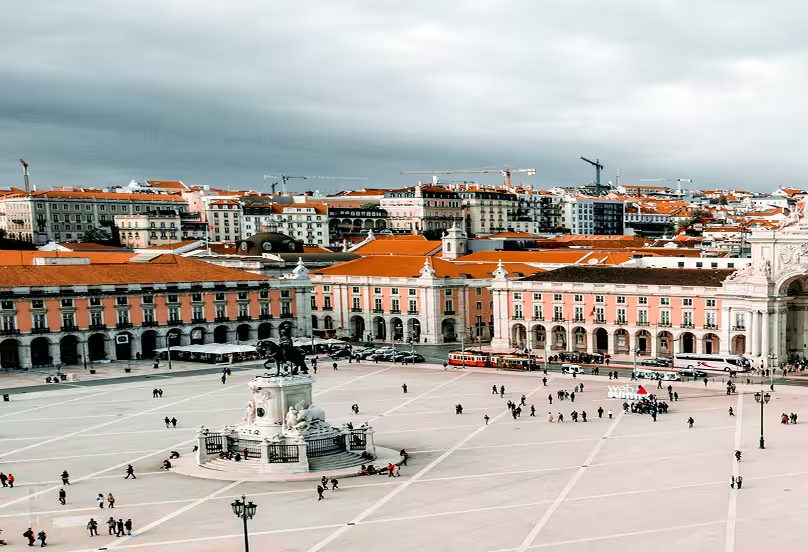
Start at Praça do Comércio, the great arcaded square opening onto the Tagus, and walk under the Arco da Rua Augusta into the Pombaline grid. Chiado above it is the bookshop and theatre quarter: Bertrand on Rua Garrett is the oldest operating bookshop in the world, and A Brasileira has been serving coffee since 1905.
Walk east along the river from Terreiro do Paço past the Ribeira das Naus lawn, where the city sits on the water in the evening. Go west and you reach Cais do Sodré, the Time Out Market and Pink Street.
Alfama, the castle and the eastern hills
Alfama is the oldest quarter and the one that survived 1755. It has no plan, and that is the point: get lost deliberately, then find your way to the Sé cathedral or the Miradouro de Santa Luzia.
São Jorge Castle sits at the top with the widest view in the city. Book online and go at opening or in the last two hours. Below it, the Fado Museum explains the music properly before you spend money on a fado dinner, and the National Tile Museum out in Xabregas is one of the best small museums in Europe, with a 23 metre panorama of Lisbon in tiles made before the earthquake.
Feira da Ladra, the flea market at Campo de Santa Clara, runs Tuesdays and Saturdays and is genuinely a flea market rather than a souvenir stall.
Belém
Six kilometres west, reachable by the 15 tram or the train. The Jerónimos Monastery and the Belém Tower are both UNESCO listed and both from the height of the maritime expansion. The Coach Museum holds the finest collection of state coaches anywhere. The Berardo Collection and MAAT cover modern and contemporary art, and MAAT's wave-shaped roof is a public walkway with a river view.
Pastéis de Belém has been making the original custard tart since 1837 to a recipe from the monastery. The queue at the takeaway window moves fast. Sitting inside is quicker than it looks.
Parque das Nações and the east
Built for Expo 98 on former industrial land, and the only part of Lisbon that is flat, modern and planned. The Oceanário is one of the largest aquariums in Europe and the best rainy-day option in the city with children. The cable car runs along the waterfront, the Vasco da Gama bridge stretches 17 kilometres across the estuary, and the whole district is walkable and pram-friendly, which is rare here.
Museums worth the ticket
- Calouste Gulbenkian Museum, one man's collection spanning Egyptian, Islamic, Asian and European art, in a modernist building surrounded by the best garden in the city
- Museu Nacional de Arte Antiga, the national collection, including Bosch's Temptation of St Anthony and the Namban screens
- Museu Nacional do Azulejo, tiles from the 15th century onwards in a convent with a gilded chapel
- Museu de Lisboa – Palácio Pimenta, for the model of the city before the earthquake
- Museu do Aljube, on resistance to the dictatorship, in the building that held political prisoners
Viewpoints
Lisbon has more miradouros than any city needs. The ones worth the climb: Senhora do Monte for the widest view, São Pedro de Alcântara for the castle across the valley, Santa Catarina for the river and the sunset, Portas do Sol for Alfama's rooftops, and Graça for the crowd. All are free.
What to Do Beyond the Sights
Eating and drinking
Eat where the menu is not translated into four languages. Grilled fish, bifana pork sandwiches, bacalhau in any of its forms, and the lunchtime prato do dia. Cerveja is beer, imperial is a small draught, vinho verde is the light green wine from the north, and ginjinha is the sour cherry liqueur sold in shot glasses off Rossio.
For a market, Time Out Market is well executed but expensive and busy. Mercado de Campo de Ourique is smaller, cheaper and more local. For a full evening, the restaurants around Rua da Bica and Santos, or the industrial-scale food halls in LX Factory under the 25 de Abril bridge.
Beaches
Carcavelos is the closest big beach, 25 minutes on the Cascais line, and the easiest with no car. Guincho, beyond Cascais, is wild, windy and for surfers. Across the bridge, Costa da Caparica has 30 kilometres of Atlantic sand and a summer beach train, and it is where Lisbon actually goes.
The water is Atlantic. It is cold in June and merely bracing in September.
Day trips
- Sintra, 40 minutes by train, for Pena Palace, Quinta da Regaleira and the Moorish castle. Go early, book tickets in advance, and accept that you cannot do all three properly in one day.
- Cascais, an hour by train, for a small harbour town with beaches and a good museum quarter.
- Óbidos, an hour by bus, a walled medieval town.
- Arrábida, an hour by car, for the best beaches within reach of the city and a mountain that drops into turquoise water.
- Évora, 90 minutes, for a Roman temple, a bone chapel and Alentejo food.
The calendar
June is the month. The Festas de Lisboa run through it, and on the night of 12 June the Santo António street parties fill Alfama, Graça, Bica and Madragoa with grilled sardines, arraial decorations and a march down Avenida da Liberdade. It is the best night of the Lisbon year and the city genuinely does it for itself.
Otherwise: Carnival in February, the Web Summit and the fado season in November, and a long warm autumn that is the best time to visit if you want the weather without the crowds.
Working and Earning in Lisbon
The employment base is broader than it looks. Shared service centres and technology operations for international companies, tourism and hospitality, financial services, the growing startup scene around Beato and Marvila, and universities and research.
Salaries are the constraint. Portuguese pay is low relative to Western Europe, which is precisely why international companies open offices here, and it is why so many of the people moving to Lisbon earn abroad. If you are on a foreign salary or a foreign pension, the maths works comfortably. If you are competing for a local job, look hard at the numbers before you commit to a rent.
Coworking is well provided. Second Home in the Mercado da Ribeira, Heden, Avila Spaces and the Beato Creative Hub among many others, with desks typically 150 to 300 euros a month.
What Changed in Lisbon in 2026
- The airport plan was formally submitted. Two runways, 56 million passengers at opening, construction 2029 to 2033, opening targeted for 2035.
- The rental law was reformed. The 2% cap on new contracts was repealed early, eviction procedures for non-payment were streamlined, and pre-1990 rents are being adjusted.
- Short-term rental rules tightened again. Lisbon's municipal regulation now puts a parish or neighbourhood into absolute containment at a 10% ratio of short-term rental units to homes, and relative containment at 5%. New registrations are blocked in absolute containment zones. The council also cancelled thousands of registrations in February 2026 for failure to prove mandatory insurance.
- Rent statistics returned. Statistics Portugal resumed publishing new-contract rents in June 2026 with a revised and wider series.
- Border procedures changed. The EU Entry/Exit System became fully operational across the Schengen area on 10 April 2026. Non-EU short-stay travellers now have facial images and fingerprints recorded electronically instead of getting a passport stamp. ETIAS, the separate pre-travel authorisation, is expected later in 2026.
- The funiculars did not come back. Only Graça is running.
Things People Get Wrong About Lisbon
- That the listing price is the price. It is not, in either direction. Registered sale prices sit below asking prices, and rental listings aimed at internationals sit above the median contract.
- That the centre is the best place to live. The historic parishes are the noisiest, the least practical and the only ones where prices fell last year.
- That it is flat, or that Google Maps understands the hills. A 900 metre walk in Lisbon can involve 60 metres of climb and four flights of public stairs.
- That the calçada is safe in the rain. The polished limestone pavement is genuinely slippery when wet. Locals change their shoes for it.
- That summer is the time to come. July and August are hot, crowded and expensive. May, June, September and October are better in every respect.
- That you can skip the tax number. You need a NIF before you can sign a lease, buy a property, open a bank account or set up utilities.
- That pickpocketing is not a thing. Lisbon is a very safe city for violent crime and a poor one for keeping your phone on tram 28 and in Baixa.
Frequently Asked Questions
Is Lisbon expensive?
Compared with Paris, Amsterdam or Dublin, no. Compared with the rest of Portugal, very. Lisbon's registered median sale price of 5,082 euros per square metre is more than twice the national median, and its median new-contract rent of 17.42 euros per square metre is roughly 84% above the national figure.
How much money do you need per month to live in Lisbon?
A single person renting a one-bedroom flat needs around 1,900 to 2,600 euros a month for a comfortable life. A couple in a two-bedroom flat needs 2,600 to 3,400. A family of four with international schooling should plan on 4,500 euros and up.
What is the average rent in Lisbon in 2026?
The median rent on new contracts signed in the municipality in the first quarter of 2026 was 17.42 euros per square metre, according to Statistics Portugal. That works out to roughly 1,045 euros for a 60 square metre one-bedroom and 1,480 euros for an 85 square metre two-bedroom. Listings aimed at international tenants typically ask more.
What is the price per square metre in Lisbon?
5,082 euros per square metre as a registered median across the 12 months to March 2026, and 5,292 euros in the first quarter of 2026 alone. By parish it ranges from around 4,300 in Olivais to just under 7,000 in Santo António.
Which is the best neighbourhood in Lisbon to live in?
For families, Campo de Ourique, Alvalade and Parque das Nações. For young professionals, Arroios, Graça and Santos. For value with good transport, Benfica, Lumiar and Olivais. For a first six months while you work out the city, anywhere central with a lift.
Can foreigners buy property in Lisbon?
Yes. Portugal places no restriction on property ownership by nationality or residency status. You need a Portuguese tax number, and non-residents face different transfer tax treatment and stricter mortgage terms than residents.
Is Lisbon cheaper than Porto?
Porto is cheaper on housing, which is the category that dominates the budget. Everything else is broadly similar. In the first quarter of 2026 the registered median in the municipality of Porto was well below Lisbon's, and rents follow the same pattern.
Is Lisbon safe?
Portugal consistently ranks among the safest countries in the world and violent crime in Lisbon is rare. Pickpocketing on tram 28, in Baixa, at Santa Apolónia and around the airport is common. Watch your bag, not your back.
Do you need to speak Portuguese in Lisbon?
You can get by in English in the centre, in hospitality and in most offices. You will need Portuguese for anything administrative, for dealing with landlords, for the health service and for making Portuguese friends. Learn European Portuguese specifically, because Brazilian courses will teach you a different accent and some different vocabulary.
How many days do you need in Lisbon?
Three full days covers the city centre, Belém and one evening of fado. Add a fourth for Sintra and a fifth for the beach or Arrábida.
Is the Elevador da Glória open?
No. It has been closed since the September 2025 accident and no reopening date has been announced. Bica and Lavra are also closed. Only the Graça funicular, which reopened in April 2026, is running.
Do I need a car in Lisbon?
Inside the city, no, and parking is genuinely difficult. If you live in Sintra, Almada or the Setúbal peninsula, or you want to reach Arrábida and the Alentejo regularly, a car earns its keep.
Planning a Move to Lisbon
The published data gives you the map. It does not give you the specific flat, the state of the building's roof, the neighbour who runs a short-term rental on your landing, or what the seller will actually accept.
Ola Estate works across Lisbon, Cascais, Oeiras, Sintra and the wider metropolitan area, in English, Portuguese and Russian. We search the whole market rather than one agency's listings, we represent the buyer or the tenant rather than the seller, our lawyers review every contract before you sign, and our mortgage broker submits to several banks at once so you can compare real offers rather than one bank's opening position.
Tell us what you are looking for and we will come back with a shortlist that fits, including video tours if you are still abroad.