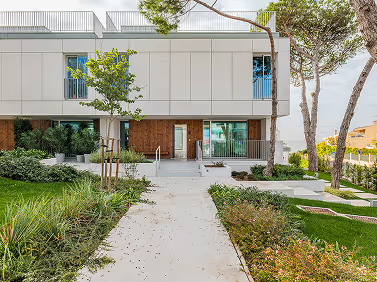

Portugal is still one of Europe's busiest property markets, and that works in your favour as a seller. Prices have climbed for years, international buyers keep arriving, and well-presented homes in the right areas tend to move quickly. Selling here does come with a specific set of steps: documents you have to gather before you can even advertise, an estate agent commission to agree, two contracts to sign, and a capital gains tax that behaves differently depending on where you pay your taxes.
This guide walks through the full process in plain terms, with the 2026 rules that matter most for owners, expats, and non-residents. Several of those rules changed recently, and a few widely repeated claims about Portuguese property tax (including some you will find on forums) are now out of date.
Key takeaways: selling in Portugal step by step
Here is the whole journey in eight steps. Each one is explained in detail further down.
- Gather your documents. You need the property's tax record (caderneta predial), the land registry certificate, and a valid energy certificate before you can legally put it on the market.
- Set a realistic price. Get a valuation, check recent completed sales near you, and leave a little room to negotiate.
- Decide how to sell. Use a licensed estate agent (commission is usually around 5% plus VAT) or sell privately.
- Market the home and host viewings. Strong photos and clean presentation matter, and you can run the whole thing remotely if you live abroad.
- Accept an offer and sign the promissory contract (CPCV). The buyer pays a deposit, commonly 10%, and both sides are then committed.
- Complete at the deed (escritura). This is signed before a notary or at a Casa Pronta office. Ownership transfers and you receive the balance.
- Settle your taxes. Declare any gain on your annual return. Residents and non-residents are both taxed on 50% of the gain at progressive rates.
- Non-EU sellers: appoint a fiscal representative. If you live outside the EU or EEA, you need one to handle the tax side of the sale.
The market in 2026: timing is on your side
Portuguese house prices have risen sharply and show little sign of cooling. The national median reached about EUR 2,076 per square metre across 2025, up roughly 17% on the year (figures from Statistics Portugal, INE). In the final quarter of 2025 alone the median hit EUR 2,198 per square metre. Compared with the rest of the European Union, Portugal posted one of the steepest annual price increases of any member state.
Two patterns help sellers. First, demand is strongest in Greater Lisbon, the Algarve, the Setubal Peninsula, Madeira, and the Porto area, where median prices sit well above the national figure. Second, buyers with a tax address abroad consistently pay more than domestic buyers, a premium of roughly a third nationally and close to half in parts of Greater Lisbon. If your property appeals to international buyers, that gap can work in your favour.
Step 1: Get your documents in order
You cannot legally advertise a property in Portugal without certain paperwork, and missing documents are the most common cause of delays. A buyer choosing between two similar homes will almost always pick the one with clean, ready paperwork. Pull these together before you list:
- Caderneta Predial Urbana. The property's tax record, issued by the Tax Authority through the Portal das Financas. It identifies the property and its taxable value (VPT). It is valid for six months, so check it is current and that the areas and details are correct.
- Certidao Permanente do Registo Predial. The land registry certificate from the Conservatoria do Registo Predial. It proves who legally owns the property and shows any mortgages or charges against it.
- Certificado Energetico (energy certificate). Required before you can advertise, not just at the sale. It rates the home from A+ to F and must be issued by an expert accredited by ADENE. It is valid for ten years. Advertising without one can result in a fine.
- Licenca de Utilizacao (use licence). Issued by the Camara Municipal, it confirms the property can be lived in. Since the Simplex Urbanistico changes of March 2024 it no longer has to be presented at the deed, but buyers and their banks still expect to see it.
- Ficha Tecnica de Habitacao. A technical data sheet listing materials and systems, required for properties built or substantially renovated after 30 March 2004.
- Photo ID and NIF. For every owner, plus spousal consent where it applies.
- Condominium declaration. For apartments or any property with shared areas, confirming condominium fees are paid up to date.
- Floor plans and, for plots of land, BUPi georeferencing. Floor plans are optional but helpful. Land must be georeferenced on the BUPi platform before a notary will complete the deed.
Step 2: Price it right
Overpricing is the quickest way to stall a sale. A listing that sits unsold loses momentum, and buyers start to wonder what is wrong with it. Get an independent valuation (estate agents and banks both offer these), and price against recent completed sales rather than the asking prices you see online, which are wish lists, not transactions. As a rule of thumb, final sale prices in Portugal tend to land a few percent below the asking price, so a small negotiating margin is sensible. In the hottest pockets of Lisbon and the Algarve, that margin shrinks and some homes sell at or above asking.
Step 3: Choose how to sell, agent or private
You are not legally required to use an estate agent, but most sellers do, especially if they live abroad or are not fluent in Portuguese. A good agent handles the valuation, photography, viewings, paperwork, and the coordination through to the deed, and screens buyers so you are not wasting time on people who cannot complete.
Commission in Portugal is commonly around 5% plus VAT (IVA at 23%), though it ranges in practice from about 3% to 10%. There is no rate fixed by law (the sector is governed by Decree-Law 153/2015), so it is negotiable. The seller pays it, and it is usually split, half when the promissory contract is signed and half at the deed. Always confirm the agency holds a valid AMI licence, and decide whether you want an exclusive mandate (one agency) or an open one (several). Listing with too many agents at once tends to spread the same photos across every portal, which can make a property look tired.
Ask how an agent will actually market the home, not just where they will list it. Professional photography is the baseline. Video walkthroughs and targeted international listings widen the buyer pool, which matters most for properties that appeal to overseas buyers willing to pay a premium.
Step 4: Market the property and handle viewings
First impressions are made in photos. Declutter, clean, fix the small things, and let in as much light as possible before the shoot. A furnished home usually photographs and shows better than an empty one. Listings typically go on the main national portals and, for internationally appealing homes, on overseas portals too. If you are selling from another country, your agent or lawyer can manage access and viewings on your behalf, so you do not need to fly back for every appointment.
Step 5: Accept an offer and sign the promissory contract (CPCV)
Once you agree a price, the next step is the Contrato de Promessa de Compra e Venda (CPCV), or promissory contract. It is not legally mandatory, and you can go straight to the deed, but it is standard practice because it commits both sides and takes the property off the market while the buyer arranges financing and final checks.
The buyer pays a deposit (sinal) when signing, commonly 10% of the price, though it can be higher. The penalty rules are strict and symmetrical: if the buyer pulls out, they forfeit the deposit; if you, the seller, pull out, you must return double the deposit. The contract is usually drafted by the buyer's lawyer and sets out the price, the deposit, the completion deadline, what is included (furniture, fittings), and any conditions, such as the buyer's mortgage being approved. Have your own lawyer review it before you sign, and once it is signed, take the listing down.
Step 6: Complete at the deed (escritura)
The sale is finalised at the Escritura Publica de Compra e Venda, the public deed, signed either at a notary's office or at a Casa Pronta one-stop service. Before the deed, the buyer pays their purchase taxes, IMT (transfer tax) and stamp duty, and the notary will not proceed without proof of payment. At signing, ownership transfers to the buyer and you receive the balance of the price, usually by certified bank cheque. Registration is fast at Casa Pronta, often one to three working days, and a little longer through a notary with separate registration.
From listing to money in the bank, a well-priced property typically takes around three to six months, with the biggest variable being how long the buyer's mortgage takes.
[[banner:w-image-1]]
headline: Selling property in Portugal?
description: See how Ola Estate helps owners sell property smarter
button: Sell with Ola Estate
url: https://www.ola-estate.com/portugal/selling
image: https://cdn.prod.website-files.com/699c52fd0ea2d4bb2148d179/69dc99ee38610685ce3c92b5_08_Conjure_AD%209%20(1).avif
color: blue
[[/banner]]
Capital gains tax (mais-valias): what you will actually pay
If you sell for more than you paid, you may owe capital gains tax, known in Portugal as mais-valias. This is the part of the process where outdated information causes real money mistakes, so it is worth getting exactly right.
Residents and non-residents now pay the same way
For Portuguese tax residents, only 50% of the gain is taxable. That half is added to your other income for the year and taxed at the progressive IRS rates, which run from roughly 12.5% to 48% for 2026, plus a solidarity surcharge of 2.5% to 5% on very high incomes. The other half of the gain is tax-free.
Here is the point many guides still get wrong. Since 1 January 2023, non-residents are taxed the same way: 50% of the gain, at progressive rates, with the rate band set by reference to your worldwide income. The old system, a flat 28% on 100% of the gain, no longer applies. The change followed a European Court of Justice ruling (Case C-388/19, March 2021) that found the previous treatment discriminatory, and Portugal wrote it into law. For most non-resident sellers the effective rate now lands somewhere between about 6% and 24%, which is equal to or better than the old 28%. The main exception is sellers based in a jurisdiction on Portugal's tax-haven blacklist, who are taxed at 35% on the full gain. The UK, US, and Canada are not on that list.
How the taxable gain is worked out
The calculation is: sale price, minus the acquisition cost (adjusted for inflation), minus your allowable costs. You are then taxed on 50% of that figure. If you have owned the property for more than 24 months, the acquisition cost is uplifted by an official inflation coefficient published each year. On a property bought in the late 1990s or 2000s, that adjustment can erase a large slice of the nominal gain, so your tax bill may be far smaller than the headline profit suggests. The tax authority applies the coefficient automatically.
You can deduct:
- IMT and stamp duty you paid when you bought the property
- Notary, registration, and legal fees on both the purchase and the sale
- The estate agent's commission on the sale
- The energy certificate
- Documented improvement work carried out in the 12 years before the sale
You cannot deduct:
- Routine maintenance and redecoration
- Mortgage interest
- Annual property tax (IMI)
Every deductible cost needs a proper invoice (factura) showing your NIF and the property address. Without compliant invoices, the cost is lost, so keep them from the day you buy. If the property is jointly owned, split the invoiced costs evenly so the deduction is shared on a joint return.
No tax is held back at the sale
Unlike Spain, which retains a percentage from non-resident sellers at completion, Portugal withholds nothing at the point of sale. You receive the full price and then self-assess the gain on your annual income tax return (Modelo 3), using Anexo G for property bought after 1989, or Anexo G1 for property bought before 1989 (which is exempt but still has to be declared). The return is filed between 1 April and 30 June of the year after the sale, and any tax is usually due by the end of August. So a property sold in 2026 is declared by 30 June 2027.
Reinvestment relief and other exemptions
Portuguese tax residents selling their main home can reduce or wipe out the gain by reinvesting. If you put the net proceeds (after repaying any mortgage on the home you sold) into another main home in Portugal, the EU, or the EEA, the gain can be fully exempt. The conditions are specific: you reinvest within a window running from 24 months before to 36 months after the sale, you declare the intention to reinvest on your tax return for the year of sale, and the home you sold must have been your main residence for at least 12 months (reduced from 24 months by a change that took effect in September 2024). If you reinvest only part of the proceeds, only a proportional part of the gain is exempt.
There are two more reliefs worth knowing. Residents aged 65 or over, or who are retired, can instead reinvest the proceeds from their main home into an eligible insurance contract or pension within six months and qualify for exemption. And under Portugal's 2026 housing measures, gains can be exempt where the proceeds are reinvested into affordable, moderate-rent housing (broadly, homes let at up to EUR 2,300 a month). These reliefs are aimed at residents; non-residents do not get the main-home rollover, which is why the deductible-costs list above matters so much for them.
Selling as a non-resident or from abroad
A sale creates a Portuguese tax obligation, which triggers a rule that catches many overseas owners. If you are tax resident outside the EU or EEA (which, since Brexit, includes the UK, as well as the US, Canada, and Switzerland), you must appoint a fiscal representative in Portugal to receive correspondence from the tax authority and handle the filing on your sale. Residents of the EU or EEA are exempt, provided they register an EU address or activate electronic notifications on the Portal das Financas. A fiscal representation service typically costs somewhere between EUR 150 and EUR 400 a year.
Selling remotely is entirely workable. Most non-resident sellers grant power of attorney (procuracao) to a Portuguese lawyer, who can sign the promissory contract and the deed on their behalf. You will usually also need a Portuguese bank account, because notaries are often unable or unwilling to transfer the sale proceeds straight to a foreign account.
One more point for owners who sold before 2023: if you were a non-resident taxed under the old rules (28% on the full gain), you may be entitled to reclaim the overpaid portion through an administrative review, but the right to do so is time-limited (broadly four years from the tax assessment). If that could apply to you, speak to a Portuguese tax adviser soon, because the window on older assessments is closing.
2026 changes sellers should know
The 2026 State Budget (Law 73-A/2025) raised the IRS income brackets by about 3.51% for inflation and trimmed the rates on the middle bands, which slightly softens the tax on a taxable gain. Separately, the government has announced a higher IMT rate for non-resident buyers (with an exemption for Portuguese emigrants), which is still being finalised in law. That measure targets buyers rather than sellers, but it could shape who can afford your property, so it is worth tracking. For UK owners, a new UK-Portugal double taxation treaty took effect on 1 January 2026, changing how tax paid in one country is credited against the other.
What it costs to sell: a quick budget
Selling costs in Portugal fall mostly on a handful of items. The buyer carries the purchase taxes (IMT and stamp duty) and usually the notary, while the seller carries the agent, their own lawyer, the energy certificate, and any capital gains tax.
Common mistakes that trip sellers up
- Assuming the old 28% non-resident tax rate, then mispricing the sale or overpaying the tax.
- Not keeping NIF invoices for purchase costs and improvements, which means losing those deductions.
- An out-of-date taxable value (VPT) on the caderneta predial, which can inflate IMI and slow the sale.
- Forgetting that IMI for the year is charged to whoever owned the property on 31 December of the previous year.
- Non-EU sellers leaving it too late to appoint a fiscal representative and missing tax authority deadlines.
- Starting to advertise before the energy certificate is issued.
Frequently asked questions
How much capital gains tax will I pay selling as a non-resident?
Since 1 January 2023, 50% of your net gain is taxable at progressive IRS rates (about 12.5% to 48% for 2026), with the band set by your worldwide income. The old flat 28% on the full gain no longer applies. Most sellers face an effective rate between roughly 6% and 24%.
Is there a withholding tax when I sell?
No. Portugal does not hold back any tax at the deed, unlike Spain. You receive the full price and declare the gain on your annual Modelo 3 return the following year.
Can I avoid capital gains tax by reinvesting?
Residents selling their main home can be exempt if they reinvest the net proceeds into another main home in Portugal, the EU, or the EEA, within 24 months before or 36 months after the sale, and declare the intention on their return. The home sold must have been their main residence for at least 12 months.
Who pays the estate agent?
The seller. Commission is commonly around 5% plus VAT, usually split half at the promissory contract and half at the deed.
How long does it take to sell?
Often three to six months for a well-priced property, depending mostly on how long the buyer's mortgage takes to approve.
Do I need a fiscal representative?
If you live outside the EU or EEA and are selling Portuguese property, yes, because the sale creates a tax obligation. EU and EEA residents are exempt if they register an EU address or switch on electronic notifications.
Can I sell from abroad?
Yes. Most non-resident sellers grant power of attorney to a Portuguese lawyer to sign on their behalf, and use a Portuguese bank account to receive the proceeds.
Selling with Ola Estate
Ola Estate helps local and international owners sell in Portugal end to end, from valuation and document preparation to viewings, contracts, and the deed, including for owners managing the sale from abroad. Our video-led marketing is built to reach the international buyers who pay a premium for the right home. To start, see our property selling service or get in touch for a valuation.