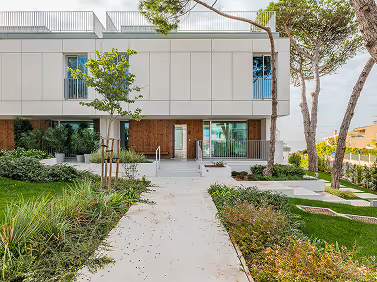

Portugal lets any foreigner rent a home, with or without a residence permit. The paperwork is light, the contracts follow a standard format, and a vacant flat can be yours within days of agreeing terms. A few specific steps trip up newcomers, and one of them, rental fraud, can cost you thousands before you ever pick up the keys. This guide walks through the whole process, from your tax number to the moment you get the keys, and flags the things foreigners get wrong.
Key takeaways: the process in six steps
- Get a Portuguese tax number (NIF) first. You can apply from abroad through a fiscal representative, and you cannot legally sign a lease without it.
- Search the main portals and through agents, and treat any deal that rushes you to pay before viewing as a likely scam.
- View the property in person, or send someone you trust, before you transfer a single euro.
- Sign a written contract (contrato de arrendamento) that states the rent, term, notice period, and deposit.
- Pay the deposit, first and last month, get a dated receipt, and confirm the landlord registers the lease with the tax authority.
- Set up your utilities. Water, power, and gas are often not connected when you collect the keys, and arranging them is your job
- Do an inventory with dated photos on the day you collect the keys.
Can a foreigner rent long-term in Portugal?
Yes, and there is no nationality restriction. EU citizens and non-EU citizens can both sign a long-term lease. You also do not need a residence permit to rent, which is a common point of confusion. What you do need is a Portuguese tax number. In practice the lease usually comes before the residence permit, because a registered rental contract is one of the documents you present as proof of address when you apply for residency.
Landlords are allowed to set their own conditions, so some prefer tenants with Portuguese income or ask for more money upfront from applicants without a local job. That is a commercial preference, not a legal barrier.
What documents do you need to rent in Portugal?
Most landlords and agents ask for the same short list. Each item below is a full requirement, not a nice-to-have.
- A Portuguese tax number (NIF) is needed to register the lease and pay rent. You can sign the contract before you have one and add it afterwards, which is perfectly legal, so a NIF that is still being processed does not have to hold up a deal.
- A valid passport, or a national ID card for EU citizens, proves your identity.
- Proof of income such as a work contract, recent payslips, bank statements, or a pension statement shows you can cover the rent.
- A Portuguese bank account is often requested, because most landlords want rent paid by local transfer.
- A guarantor (fiador) is sometimes required, though there are common workarounds covered further down.
How do you get a NIF as a foreigner?
The NIF is free, and where you apply depends on your residency.
- EU and EEA residents can apply in person at a Finanças office or a Loja do Cidadão, and the number is usually issued on the spot.
- Non-EU residents applying from outside the bloc must appoint a fiscal representative, a person or firm that is tax-resident in Portugal and acts as your contact with the tax authority. This requirement is set out in Portugal’s official guidance for foreign citizens.
Many people arrange a NIF remotely before they fly over, which lets them sign a lease as soon as they find a place they like.
Where should you look for an apartment?
Online property portals are the main starting point and let you filter by city, price, number of bedrooms, and whether the flat is furnished. Portuguese listings use the T notation, so a T1 is a one-bedroom flat and a T3 is a three-bedroom. Local estate agents (mediadores imobiliários) know the market well and are worth using in tight cities like Lisbon and Porto. Many foreigners also find homes through Facebook groups and word of mouth, which can mean lower prices but also less protection.
If you would rather not handle the search yourself, Ola Estate can help you rent the ideal apartment. We find places that match your brief, arrange the viewings, vet the landlord and the listing so you are not exposed to fraud, and take you through the contract, including fully remote searches if you are still abroad.
How do you stand out when good flats get multiple offers?
Good apartments in Lisbon, Porto, Cascais, and the Algarve attract several applicants at once. Agents often show a place to only five or six people, then collect written offers, and the landlord frequently picks the tenant who looks most reliable and long-term rather than the highest bidder. A few things make your application stand out.
- Introduce yourself briefly: what you do, why you are moving to Portugal, and that you plan to stay long-term.
- Offer a longer contract if you can. Two years or more is attractive to landlords and still leaves you free to leave earlier with notice.
- Put more on the table upfront. A larger deposit or several months paid in advance lowers the landlord's risk and often wins the flat, which matters most if you are new to the country or self-employed.
- Add a short personal profile, plus a photo of you and any co-tenants. Landlords rarely meet tenants in person and lean on that impression.
How much does renting cost in Portugal?
Rents have been climbing for years. According to Statistics Portugal (INE), the median rent on new leases reached €8.22 per square metre in the first quarter of 2025, up 10 percent on the year before, across more than 23,000 new contracts. To turn that into a monthly figure, multiply by the floor area, so an 80 square metre flat at the national median works out around €660. Lisbon, Porto, the Algarve, and the Setúbal area sit well above that, while inland towns are cheaper, so check current listings for the exact area you want.
Budget for the upfront costs as well as the monthly rent.
- A security deposit (caução) of one to two months’ rent is standard.
- The first and last month's rent are normally paid upfront together. Paying only the first month is rare, so budget for both.
- Some landlords ask foreigners without local income for extra months upfront, which is legal as long as it is written into the contract.
Plan on roughly three to four months' rent in total to move in.
[[banner:w-image-1]]
headline: Looking for a long-term rental in Portugal?
description: We help expats find and secure long-term rentals remotely
button: Explore rental support
url: https://www.ola-estate.com/portugal/renting
image: https://cdn.prod.website-files.com/699c52fd0ea2d4bb2148d179/69d3c297a90daeeab9240bb8_Container-5.avif
color: orange
[[/banner]]
What goes into the rental contract?
The contract is called a contrato de arrendamento, and it must be in writing. A proper lease states the following.
- The names and tax numbers of both the landlord and the tenant appear at the top.
- The monthly rent, the payment date, and the payment method are fixed.
- The length of the lease and how it renews are set out clearly.
- The notice period each side must give to end the lease is defined.
- Responsibility for utilities, condominium fees, and repairs is assigned.
- The size of the deposit and the exact conditions and timeline for returning it are written down. Aim for the deposit to come back within 15 to 30 days of a clean handover, and be wary of contracts that stretch this to 60 days.
Most long-term leases start at one year and renew automatically unless one side gives notice. Contracts are written in Portuguese, so get a translation if you are not comfortable with the language, and never accept an informal arrangement with no written contract.
Why the contract must be registered with the tax authority
This is the step most guides skip, and it matters more to foreigners than to anyone else. The landlord must declare the lease to Finanças (the tax authority) and pay stamp duty (imposto do selo) of 10 percent of one month’s rent. A registered lease helps you in three concrete ways.
- It is your proof of address for residence permit and visa renewals.
- It lets you deduct part of your rent on your Portuguese tax return.
- It confirms the landlord is declaring the income, which is a strong sign the arrangement is genuine.
Since 1 August 2025, the rules tilted further toward tenants. As The Portugal News reported, renters can now declare the lease themselves on the Finanças portal if the landlord fails to do so, which also opens access to rent support schemes and the income tax deduction. If a landlord refuses to register the contract at all, treat it as a warning sign and consider walking away.
How much can your rent go up each year?
For existing contracts, annual increases are capped by law. The ceiling is set at 2.24 percent for 2026 under the New Urban Lease Regime (NRAU). The increase is optional rather than automatic, and the landlord must give written notice at least 30 days before the contract’s anniversary. New leases are not capped, so the starting rent on a fresh contract is whatever the market will bear, which is why moving into a new lease in a hot city costs more than staying put.
What if you are asked for a guarantor (fiador)?
A fiador is a Portuguese resident who guarantees your rent if you stop paying. Foreigners rarely have someone who can take this on, so landlords and tenants use a few standard alternatives.
- You offer several months’ rent in advance, which many landlords accept instead of a guarantor.
- You take out rent-guarantee insurance (seguro de renda), where an insurer backs your payments.
- You agree to a larger deposit.
- You provide strong proof of income, such as a long employment contract or healthy savings.
Whatever you agree, get it written into the contract so there is no dispute later.
[[banner:w-image-1]]
headline: Want the full rental guide?
description: Get our free guide to renting in Portugal, including documents, deposits and common pitfalls
button: Download the guide
url: https://drive.google.com/file/d/1Oi5NebqvGEflHopg8FKV8GM1ORjnXr7y/view
image: https://cdn.prod.website-files.com/699c52fd0ea2d4bb2148d179/69dc99ee38610685ce3c92b5_08_Conjure_AD%209%20(1).avif
color: blue
[[/banner]]
How do you avoid rental scams in Portugal?
This is the single biggest risk for anyone renting from abroad. Police in Portugal regularly warn about rental fraud that follows a clear pattern. Scammers copy photos of a real home into a fake advert priced below the market, pose as the owner, and pressure you to pay a deposit fast to reserve the place, often without any in-person viewing. Once you transfer the money, contact stops. The defences are simple and worth following without exception.
- Never pay a deposit before viewing the property in person, or sending someone you trust to view it for you.
- Be suspicious of any price that sits clearly below similar flats nearby.
- Confirm the person letting the property actually controls it, and ask to see proof of ownership such as the caderneta predial.
- Keep every message, contract, and receipt, all with dates.
- Pay in a way that is traceable, and avoid instant mobile transfers to a stranger.
- Ask for a dated receipt for every payment, tied to your NIF.
If you are targeted, report it to the PSP or GNR and instruct your bank to attempt a recall straight away.
What should you check at the viewing and handover?
A viewing is your chance to catch problems that photos hide, and the handover is your chance to record the flat’s condition before you are liable for it.
- Look for damp and mould, especially in older buildings, since many Portuguese homes have limited heating and humid winters.
- Be wary of freshly repainted patches or corners, which can hide leaks or mildew, and look for any sign of pests such as cockroaches or rodents.
- Test the water pressure, the hot water, and how well the windows shut out cold and noise.
- Check how the hot water is heated. A gas tankless heater gives instant, cheaper hot water, while an electric tank can run out after a long shower.
- Note the flat's orientation and heating. South-facing rooms get winter sun and need less heating, and many flats have no fixed heating or cooling at all, so check before winter.
- Confirm which appliances stay and check that they work.
- You normally have a short window after moving in, commonly around 30 days, to report anything that does not work. Faults present on day one are the landlord's responsibility to repair, so put them in writing straight away.
- Walk through the inventory on handover day, photograph everything with a date, and add any existing damage to the document before you sign it.
Do the utilities come connected?
This surprises many newcomers. It is common to collect the keys and find no active water, electricity, gas, or internet, and setting them up is the tenant's job, not the landlord's. You may face one of three situations: the contracts stay in the landlord's name and you reimburse the bills, the services are already active and you simply change the account into your name, or there are no active contracts and you start from scratch, which takes roughly three working days per service.
To set up utilities in your name you usually need your NIF, the signed lease, and a Portuguese phone number, plus the CUI code printed near the meter for gas. EDP is the best-known electricity and gas provider, while water is run by the local municipal company. Photograph the meter readings on the day you move in, and schedule any gas activation last, since the technician needs running water and power to test the appliances.
Frequently asked questions
Do I need a residence permit to rent in Portugal?
No. You need a NIF. A residence permit is a separate process, and your registered lease often serves as proof of address when you apply for one.
Can I rent before I arrive in Portugal?
Yes, but never transfer a deposit for a home that you or someone you trust has not seen in person.
How many months’ rent do I need upfront?
Plan for a deposit of one to two months plus the first and last month's rent, so roughly three to four months in total.
Are rental contracts in English?
Usually not. They are written in Portuguese, so get a certified translation if you are not fluent.
Who pays to register the lease?
The landlord is legally responsible, but since August 2025 you can register it yourself if they fail to.
The bottom line
Get your NIF sorted early, insist on a written and registered contract, and never pay for a home you have not seen. Those three habits handle most of what goes wrong for foreign renters in Portugal, and they leave you free to enjoy the part that brought you here.
Looking for a long-term rental in Portugal?
Ola Estate searches on your behalf, arranges viewings, vets the landlord, and checks the contract before you sign, including remote searches if you are still abroad. Get in touch and we will map out the area, budget, and paperwork.